 |
Code Documentation 3.8
Social Network Visualizer
|
|
Code Documentation 3.8
Social Network Visualizer
|
Records how to re-apply one filter operation from scratch. More...
#include <graph/filters/filter_spec.h>
Public Types | |
| enum class | Type { None , Attribute , Selection , Ego , Centrality , EdgeAttribute , EdgeWeight , Query , EdgeQuery } |
Public Attributes | |
| Type | type = Type::None |
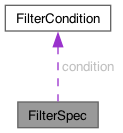
| FilterCondition | condition |
| int | egoVertex = 0 |
| int | egoDepth = 1 |
| QList< int > | selection |
| float | centralityThreshold = 0.0f |
| bool | centralityOverThreshold = false |
| SocNetV::IndexType | centralityIndex = SocNetV::IndexType::DC |
| float | edgeWeightThreshold = 0.0f |
| bool | edgeWeightOverThreshold = false |
| QList< FilterCondition > | queryConditions |
Records how to re-apply one filter operation from scratch.
One FilterSpec is embedded in every GraphVisibilitySnapshot. When the user removes an arbitrary filter chip, Graph::vertexFilterRemoveAt() restores to the pre-first-filter base state and replays the remaining specs in order via vertexFilterReplaySpec().
Every filter operation (node OR edge) pushes exactly one snapshot, so the filter bar's chip order maps 1:1 to the snapshot stack (barIndex == stackIndex). This invariant is maintained by chipCloseRequested using barIndex directly.
Centrality replay requires the relevant index to still be computed; if it is not, vertexFilterByCentrality() returns early with a status message and that step is silently skipped during replay.
|
strong |
| SocNetV::IndexType FilterSpec::centralityIndex = SocNetV::IndexType::DC |
| bool FilterSpec::centralityOverThreshold = false |
| float FilterSpec::centralityThreshold = 0.0f |
| FilterCondition FilterSpec::condition |
| bool FilterSpec::edgeWeightOverThreshold = false |
| float FilterSpec::edgeWeightThreshold = 0.0f |
| int FilterSpec::egoDepth = 1 |
| int FilterSpec::egoVertex = 0 |
| QList<FilterCondition> FilterSpec::queryConditions |
| QList<int> FilterSpec::selection |
| Type FilterSpec::type = Type::None |
 1.16.1