
SocNetV v3.8 Released
SocNetV v3.8 released! 🎉
We are happy to announce the release of SocNetV v3.8!
This release brings first-class support for signed networks — networks where a tie can be positive or negative, not just present or absent — with two new purpose-built centrality measures, negative-weight-safe shortest paths, and full GUI/report/CLI support. It also parallelizes several core measures for a real speedup on large networks and switches Graph Connectivity to a much faster algorithm. Read on for details.
🔍 What’s New in SocNetV v3.8?
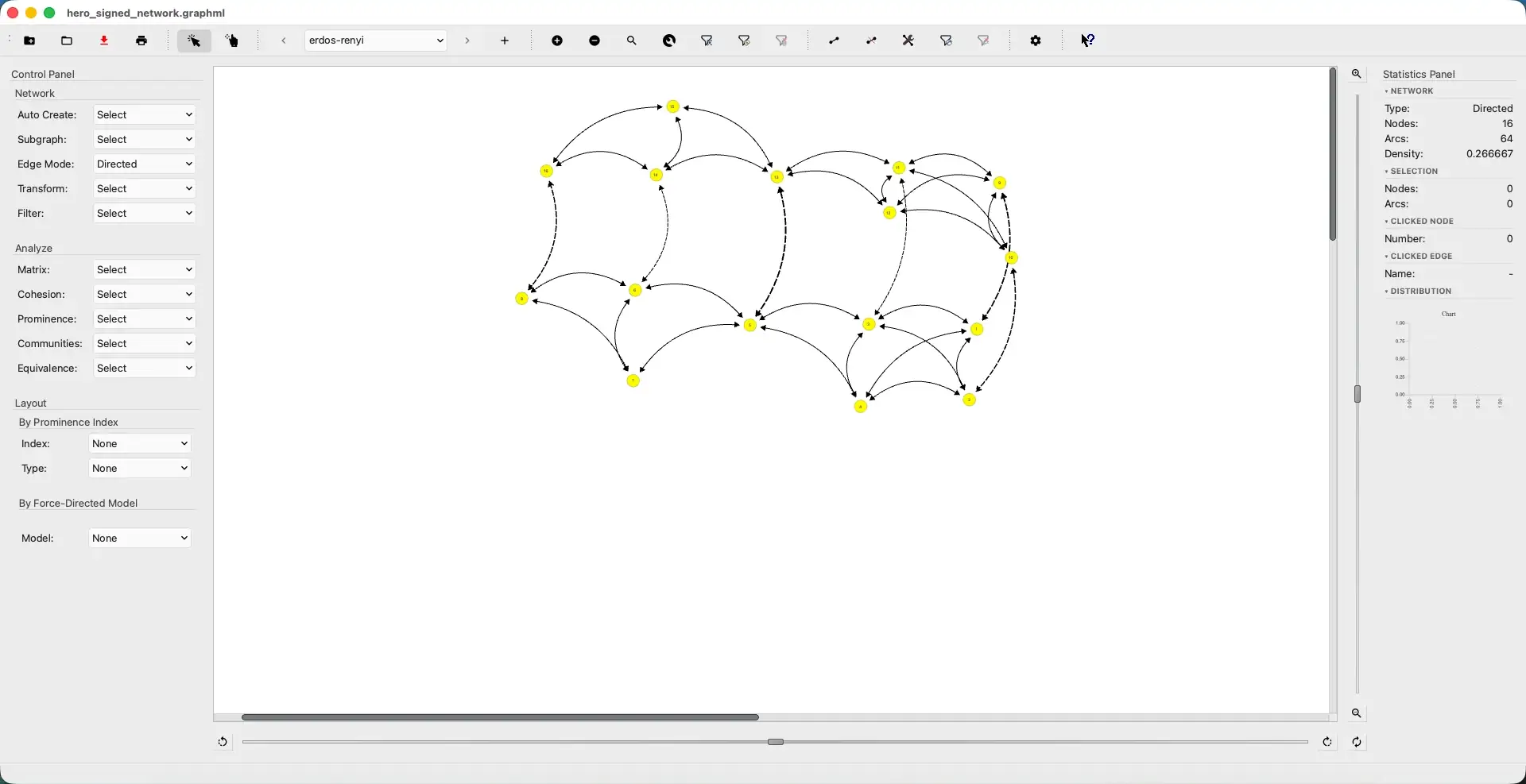
➕➖ Signed Network Support
SocNetV can now tell friend from foe. Negative edge weights are no longer just tolerated — they’re first-class citizens throughout the app:
- Negative-weight-safe shortest paths: distance-based measures (Distance, Average Distance, Geodesic Distances Matrix) now offer to upgrade to a Bellman-Ford/Johnson’s-algorithm-based computation when a network has negative weights, instead of just refusing. A reachable negative cycle is still correctly refused, since shortest paths are undefined there.
- Signed Degree Centrality: splits each actor’s out-degree by tie sign into four scores — positive ties sent, negative ties sent, their ratio, and their net balance.
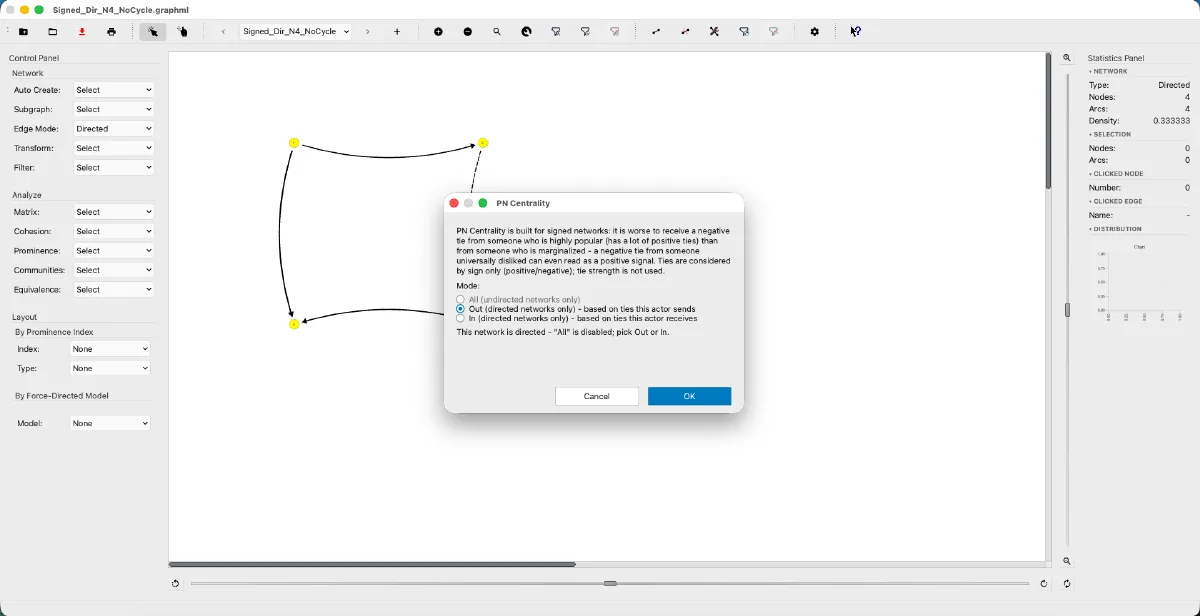
- PN Centrality (Everett & Borgatti, 2014): the standard purpose-built centrality measure for signed networks. The core idea: a negative tie from someone who is themselves highly prominent hurts more than one from someone marginalized — propagated through the whole network the same way Katz Centrality propagates ordinary ties. Three modes (undirected, directed-out, directed-in), each disabled or enabled automatically depending on your network’s directedness.
Both measures are available from Analyze → Centrality and Prestige indices, the Prominence toolbox combo, and as --interactive-script commands for headless automation.
⚡ Faster on Large Networks
Several core measures now compute in parallel across all your CPU cores instead of one vertex at a time: Degree Centrality, Clustering Coefficient, Triad Census, Closeness (IR), Degree Prestige, Proximity Prestige, and four internal matrix-fill operations (shortest paths, distances, reachability, adjacency). Measured wins range from roughly 2x to over 6x on large networks, depending on the measure — Triad Census alone dropped from over a minute to about 15 seconds on a 1,000-node/10,000-edge network.
🔗 Faster Graph Connectivity
Graph Connectivity (κ(G)) now uses the Esfahanian-Hakimi (1984) algorithm instead of a full pairwise sweep — provably exact, same results, dramatically fewer computations. A synthetic network that previously hung for over 30 minutes now completes in about 9 seconds.
🛠 Other Improvements
- More accurate Betweenness, Stress, and Eccentricity Centrality, diameter, and average distance on weighted networks.
- Hierarchical clustering now handles isolated vertices correctly and gained a true UPGMA linkage method alongside the existing WPGMA one.
- Similarity/Pearson reports no longer produce NaN on small networks.
- DL and Adjacency format parsers no longer silently drop negative-weight edges on import.
- Several memory leaks in
Matrixoperations fixed.
See the CHANGELOG for the complete list.
Download SocNetV v3.8 from our Downloads page and let us know what you think!
Happy analyzing! — The SocNetV Team